
Urgent and Important: avoiding the urgent trap

When Coaching CEOs we use this model to focus on the things that require it. Working in quadrant one, then two, not getting caught up in quadrant 3.
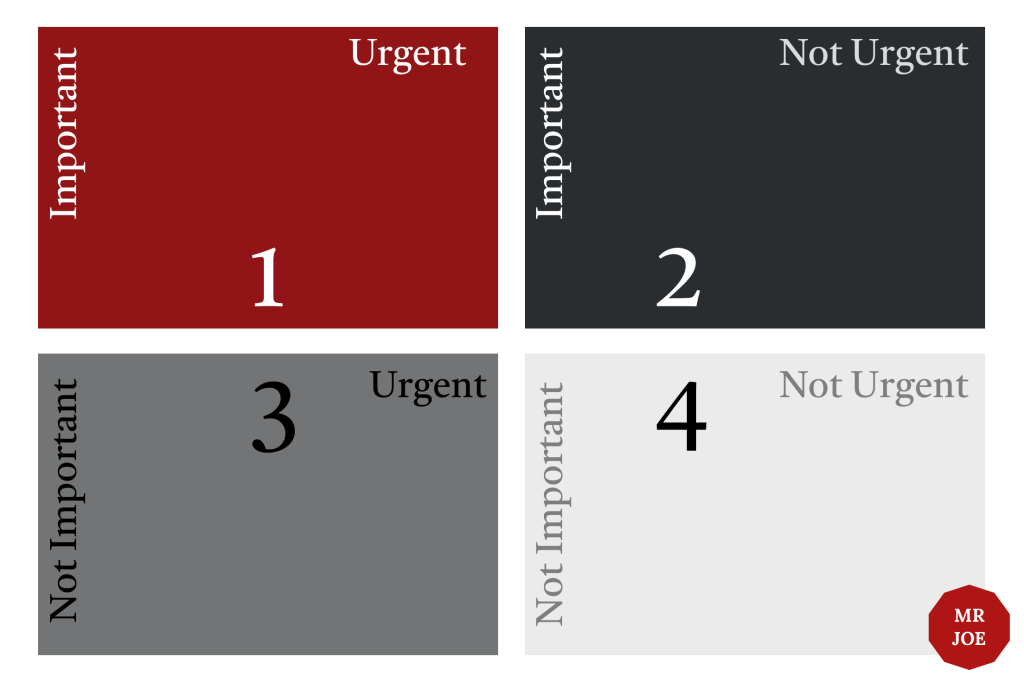
The Covey Quadrants, popularised by Stephen R. Covey in The 7 Habits of Highly Effective People, is a time management framework to prioritise tasks based on their urgency and importance. The framework is represented as a 2×2 matrix:
Quadrant Overview
1. Quadrant 1: Urgent & Important (Crisis)
Tasks that require immediate attention and have significant consequences.
• Examples: Crises, pressing problems, last-minute deadlines.
• Action: Address immediately.
2. Quadrant 2: Not Urgent & Important (Growth)
Tasks that contribute to long-term success and personal/professional development.
• Examples: Strategic planning, relationship building, self-care, skill improvement.
• Action: Schedule and prioritise to prevent future crises.
3. Quadrant 3: Urgent & Not Important (Distractions, the TRAP!)
Tasks that feel urgent but don’t contribute meaningfully to goals. An easy place to get trapped.
• Examples: Interruptions, some meetings, unnecessary emails.
• Action: Delegate or minimise.
4. Quadrant 4: Not Urgent & Not Important (Time-Wasters)
Tasks that neither demand immediate attention nor add value.
• Examples: Excessive social media, trivial activities, mindless entertainment.
• Action: Avoid or eliminate.
Key Takeaway
Focus most of your time in Quadrant 2 to proactively manage your life, reduce time spent in Quadrant 1, and don’t get trapped in Quadrant 3.