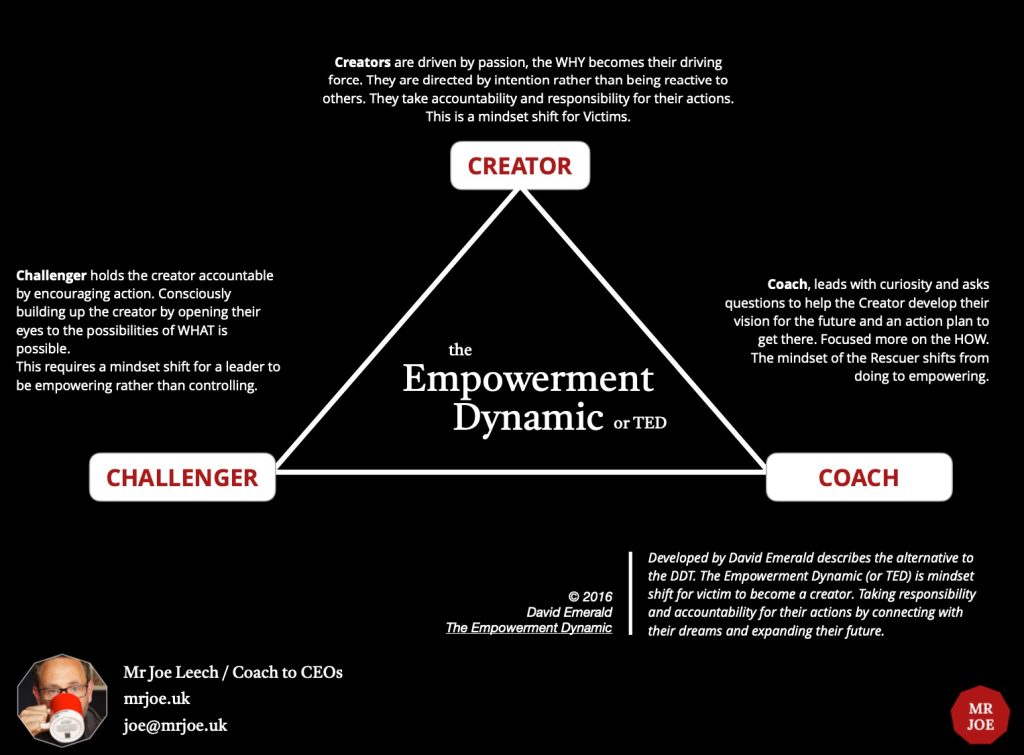
The Empowerment Dynamic

TED* empowers you to consciously choose your responses to life’s events, creating a life of purpose and resilience.
The Empowerment Dynamic (TED*) offers a transformative shift from drama-filled reactions to empowered, intentional responses to life’s challenges. As an antidote to the Drama Triangle—defined by the roles of Victim, Persecutor, and Rescuer—TED* introduces the empowering roles of Creator, Challenger, and Coach.
By embracing this framework, individuals and teams move away from blame and dependency, fostering relationships and actions rooted in accountability and growth. TED* empowers you to consciously choose your responses to life’s events, creating a life of purpose and resilience.
Resources
- Book: Power of TED Summary (The Empowerment Dynamic)
- PDF Download
Drama Triangle
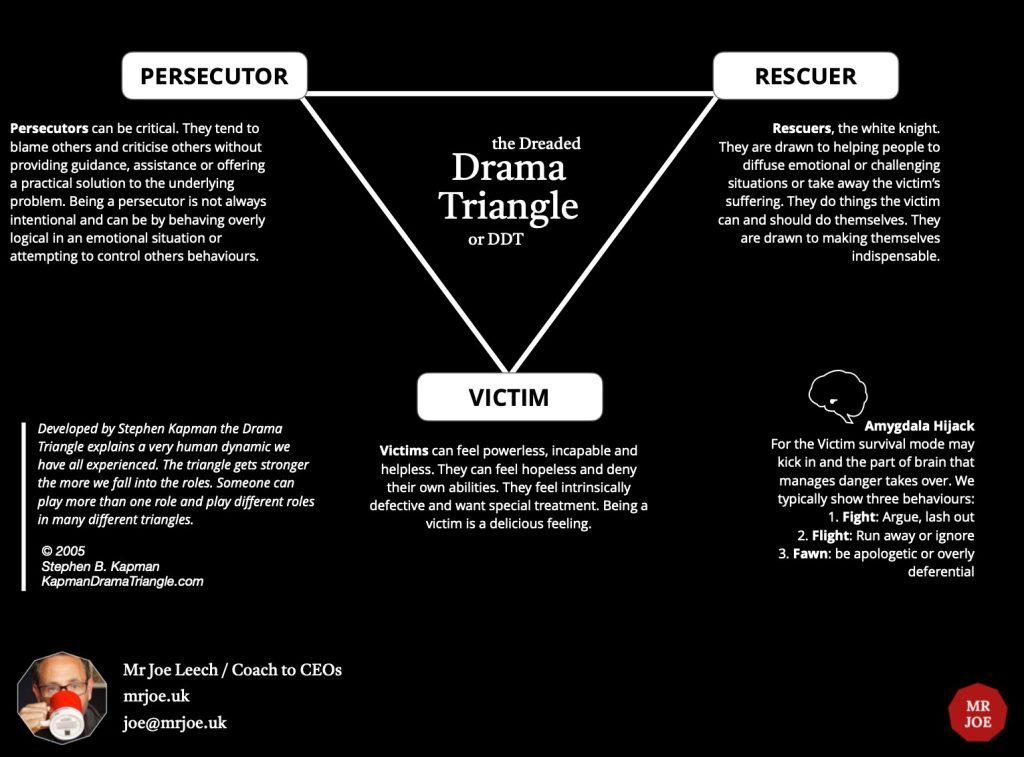
The Victim: The Victim in this model is not intended to represent an actual victim, but rather someone feeling or acting like one.[1] The Victim seeks to convince themself and others that they cannot do anything, nothing can be done, all attempts are futile, despite trying hard.
One payoff for this stance is avoiding real change or acknowledgement of their true feelings, which may bring anxiety and risk, while feeling they are doing all they can to escape it. As such, the Victim’s stance is “Poor me!” The Victim feels persecuted, oppressed, helpless, hopeless, powerless, ashamed, and seems unable to make decisions, solve problems, take pleasure in life, or achieve insight.
The Victim will remain with a Persecutor or, if not being persecuted, will set someone else up in the role of Persecutor. They will also seek help, creating one or more Rescuers to save the day, who will in reality perpetuate the Victim’s negative feelings and leave the situation broadly unchanged.
The Rescuer: The Rescuer’s line is “Let me help you.” A classic enabler, the Rescuer feels guilty if they don’t go to the rescue, and ultimately becomes angry (and becomes a Persecutor) as their help fails to achieve change. Yet their rescuing has negative effects: it keeps the Victim dependent and doesn’t allow the Victim permission to fail and experience the consequences of their choices. The rewards derived from this rescue role are that the focus is taken off of the Rescuer, who can also feel good for having tried, and justified in their negative feelings (to the other actor/s) upon failing. When they focus their energy on someone else, it enables them to ignore their own anxiety and issues. This rescue role is also pivotal because their actual primary interest is really an avoidance of their own problems disguised as concern for the Victim’s needs.
The Persecutor: (a.k.a. Antagonist / Villain) The Persecutor insists, “It’s all your fault.” The Persecutor is controlling, blaming, critical, oppressive, angry, authoritarian, rigid, and superior. But, if blamed in turn, the Persecutor may become defensive, and may switch roles to become a Victim if attacked forcefully by the Rescuer and/or Victim, in which case the Victim may also switch roles to become a Persecutor.
Empowerment Triangle